When Is Your Brand Ready for an Affiliate Program?
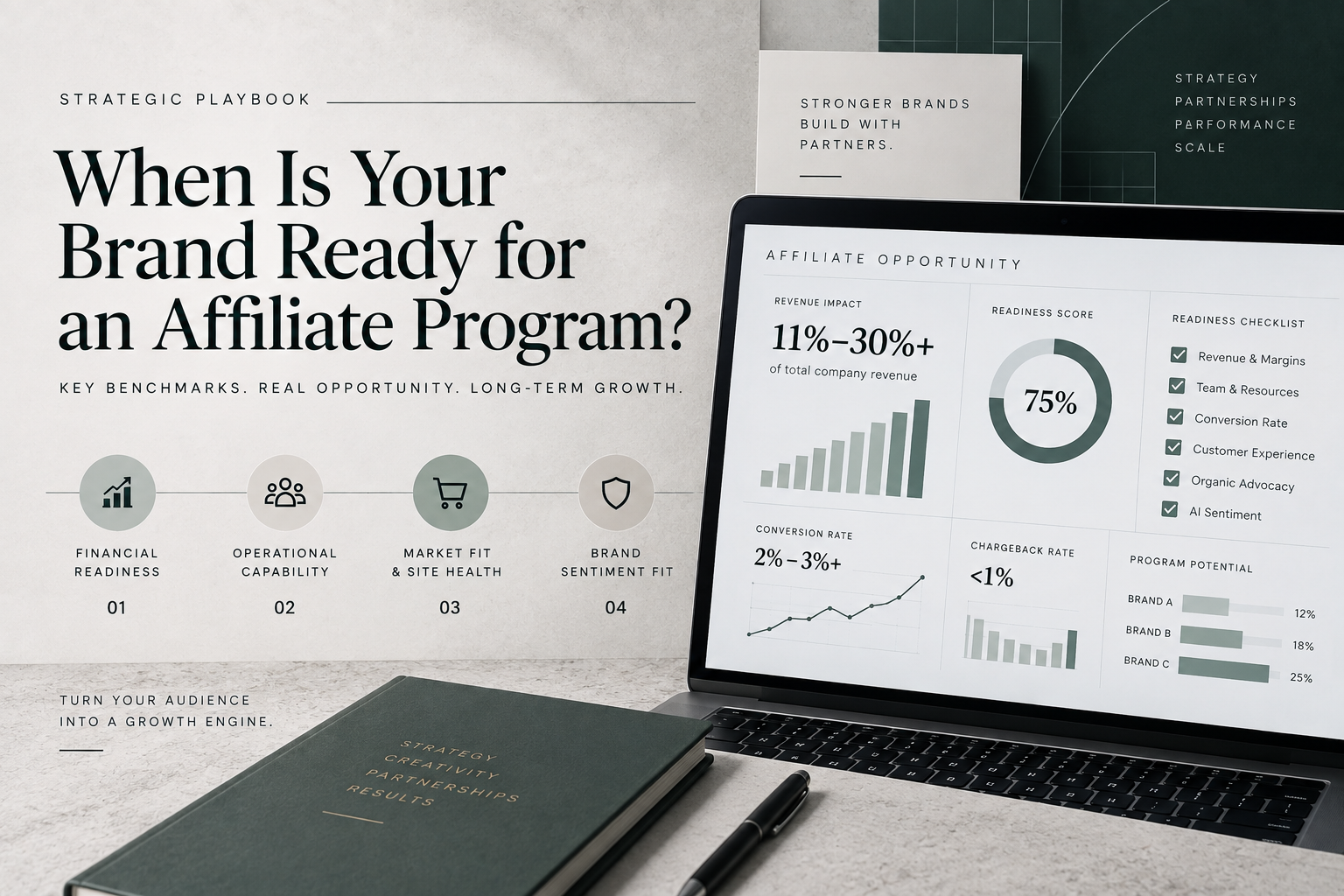
Timing is everything when launching an affiliate marketing channel. Enter the space too early, and you risk burned capital, disengaged partners, and a stagnant program. Enter at the right time, and affiliate marketing can drive 11% to 30%+ of your overall company revenue.
Before investing budget into affiliate tracking software, management agencies, or partner recruitment, evaluate your business against these core readiness benchmarks.
1. Financial Readiness: Numbers That Make Sense
Affiliate marketing operates on performance, but launching and scaling a program requires baseline capital and comfortable margins.
- Annual Revenue Benchmark: A general baseline to ensure operational scale is $10M in annual sales. At this stage, your brand typically has the infrastructure, brand recognition, and order volume needed to attract top-tier partners.
- Margin Capacity: You need healthy profit margins (typically 10–30% for physical goods, and significantly higher for digital/SaaS goods).
The Full Cost Structure: Remember that your gross margin must cover more than just partner payouts. Your unit economics must accommodate:
- Affiliate Commissions: Performance incentives for driving conversions.
- Platform & Infrastructure Costs: Software fees for tracking, attribution, and automated partner payouts.
- Creative Support: Ongoing investment in promotional banners, co-branded landing pages, and product samples.
- Expert Oversight: Budget for an affiliate agency or dedicated in-house team if your current staff lacks the time or domain expertise.
2. Team & Operational Capability: The Human Capital Metric
An affiliate program is not a 'set it and forget it' revenue engine; it is a relational sales channel.
According to data highlighted in Impact’s State of Affiliate Marketing Report, a successful program requires deep industry knowledge, mastery of performance platforms, and existing partner relationships.
- The Scale Ratio: To effectively recruit, activate, and manage a high-performing group of 100 active affiliates, it takes approximately 5 dedicated team members (or an equivalent agency setup).
- Full-Funnel Management: Your team must be capable of recruiting partners across every stage of the customer journey—from top-of-funnel creators and niche content publishers to bottom-of-funnel review sites and loyalty partners.
3. Market Fit & Site Health: Converting the Traffic You Get
Affiliates send prospective buyers to your site, but they cannot fix a broken customer experience or weak offer. You must prove Product-Market Fit across positioning, conversion, and retention before asking partners to risk their audience on your brand.
Key Performance Indicators (KPIs)
- Conversion Rate: A minimum baseline site conversion rate of 2% to 3%. If your site converts below this, affiliates will struggle to earn, leading to rapid drop-off and churn.
- Low CS Friction: Minimal customer service backlog and streamlined post-purchase support.
- Healthy Chargeback Rates: A clean payment profile with a chargeback rate well below 1%, with a target of .6% or below.
Organic Advocacy Signals
Are organic advocates appearing before you ask them? Signs of organic pull include:
- Unsolicited Brand Mentions: Active discussion across Reddit, niche forums, and social channels.
- Positive Review Stream: A steady, recurring stream of verified customer reviews.
- Inbound Partner Inquiries: Requests from creators or site owners asking if you offer an affiliate or referral program.
4. Brand Sentiment Fit: The LLM & AI Consensus
Modern consumers—and modern search engines—evaluate brands through synthetic aggregation. A critical, emerging consideration for launching an affiliate program is your overall Brand Sentiment Fit across Large Language Models (LLMs) and AI engines.
LLMs look for cross-web consensus across four core pillars:
- 1. Perceived Value: Cost-to-quality alignment in market feedback.
- 2. Ease of Usability: Frictionless customer onboarding and UI/UX experience.
- 3. Customer Support Quality: Speed, empathy, and effectiveness of support staff.
- 4. Reliability & Security: Trustworthiness, delivery accuracy, and data security.
When potential affiliates or end-consumers use AI tools to research your product category, the LLM synthesizes web sentiment to generate recommendations.
The Sentiment Target: Aim for an LLM Sentiment Score above 75%. This threshold indicates that AI models view your brand positively, consistently, and reliably across public sources. High brand sentiment gives affiliates the confidence that sending traffic to your business will protect their own audience's trust.
Program Readiness Checklist
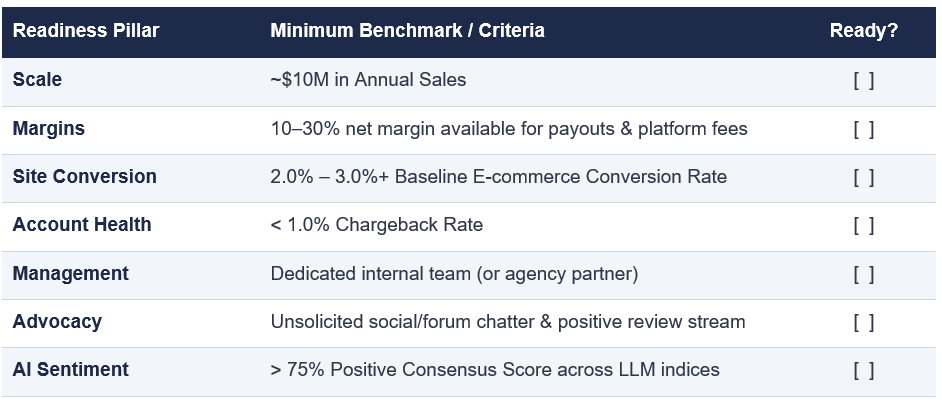
Evaluate your brand's readiness status across these primary benchmarks:
Assess Your Program Readiness
If your brand checks most of these boxes—or if you want to evaluate your standing before making a capital commitment—we can help.
Reach out today for a complimentary assessment, including:
- LLM Scorecard Analysis: Evaluating your brand's AI sentiment and cross-web consensus.
- Competitive Landscape Overview: Benchmarking commission structures and partner density against category leaders.
- Comprehensive GAP Analysis: Identifying funnel friction points and affiliate program launch readiness.